BIM in Construction: From Trend to Global Reality
BIM is no longer optional. In this article, we analyze its impact on the construction sector and compare the level of adoption in leading markets such as the UK, USA, France, Germany, and Brazil.
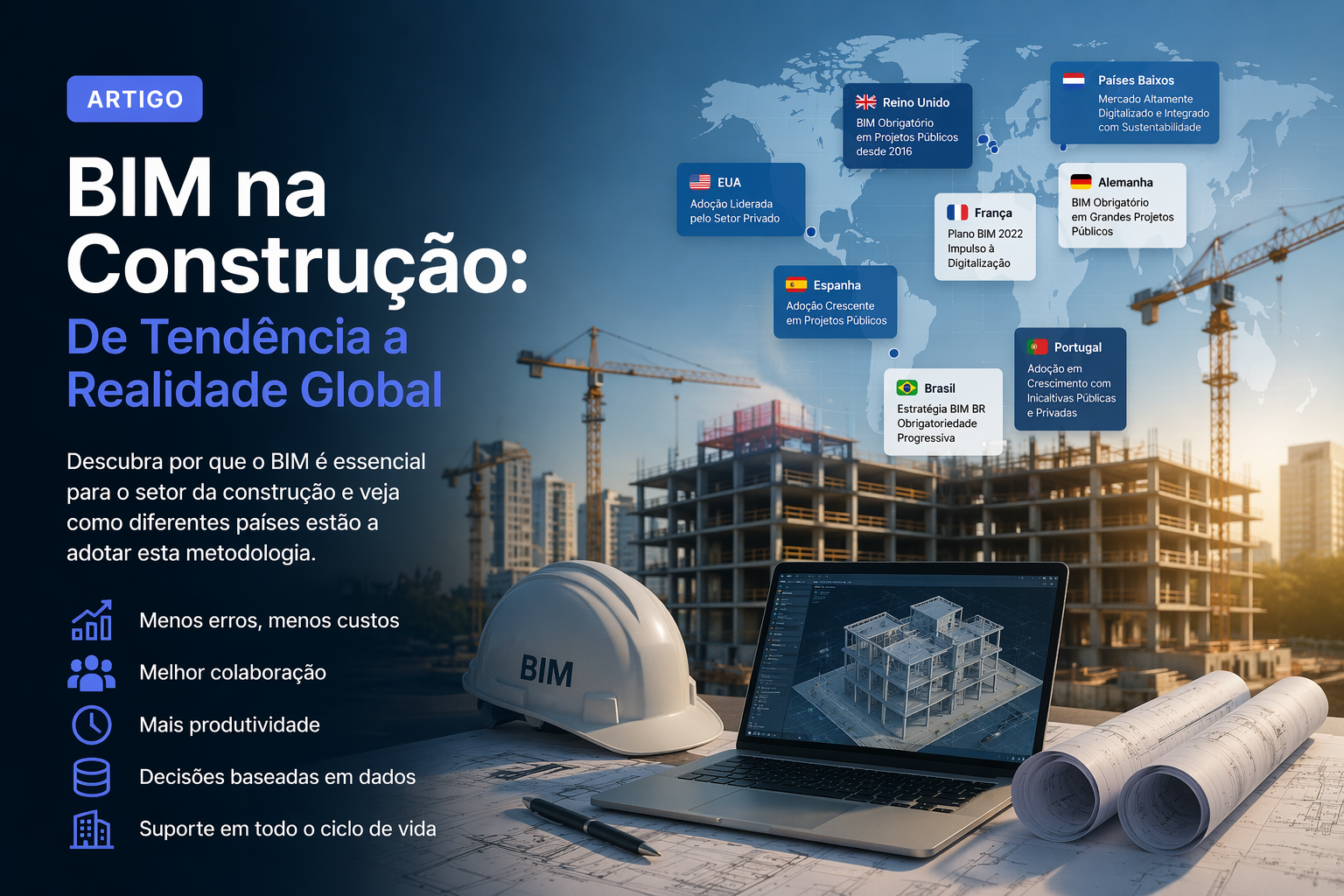
BIM in Construction: From Trend to Global Reality
Introduction
Building Information Modeling (BIM) has evolved from an emerging innovation into an essential standard in the construction sector. Governments, developers, and construction companies are adopting BIM as a mandatory requirement to increase efficiency, reduce risks, and ensure better control over projects.
Its adoption is directly linked to the growing need for digitalization in the sector, historically marked by low productivity and high fragmentation.
Why BIM is Critical for the Construction Sector
1. Reduction of errors and rework
BIM allows conflicts (clashes) to be identified before construction, significantly reducing the costs associated with on-site errors.
2. Better coordination between teams
Architecture, structures, and specialties work on a centralized model, ensuring information alignment and consistency.
3. Increased productivity
Process automation and information reuse accelerate project and execution phases.
4. Data-driven decision making
BIM allows quantitative and qualitative information to be extracted in real time, supporting more informed decisions.
5. Asset lifecycle support
From design to operation (Facility Management), BIM ensures information continuity.
International Benchmark: BIM as a Reality
BIM adoption varies between countries, but the most mature markets already clearly demonstrate its benefits.
United Kingdom
The United Kingdom is one of the most advanced cases:
- BIM mandatory for public projects since 2016
- Strong standardization (UK BIM Framework)
- High digital maturity in the sector
United States
- Adoption led by the private sector
- Large companies and projects already extensively use BIM
- Strong integration with technologies like Digital Twins and IoT
France
- Government plan (Plan BIM 2022)
- Incentive for sector digitalization
- Growing adoption in public and private projects
Germany
- Gradual strategy with a focus on infrastructure
- BIM mandatory for large-scale public projects
- Strong technical demand and rigor in implementation
Netherlands
- One of the most digitized markets in Europe
- BIM widely used throughout the project lifecycle
- Strong integration with sustainability
Spain
- Growing adoption driven by public requirements
- BIM mandatory for certain public projects
Brazil
- BIM BR strategy defined by the government
- Progressive mandatory use in public projects
- Rapidly growing market with great potential
Portugal
- Adoption still in a growth phase
- Public and private initiatives driving usage
- The lack of general mandatory use still limits scale
Conclusion
BIM is no longer a competitive advantage; it is a requirement to compete in the modern construction sector.
Companies that adopt BIM:
- Reduce costs
- Increase efficiency
- Improve project quality
- Gain an advantage in public and private tenders
On the other hand, companies that do not adopt BIM face a growing risk of market exclusion.
The Role of Digital Platforms
The complexity of BIM requires tools that allow for:
- Centralizing information
- Facilitating Collaboration
- Automating processes
- Scaling operations
Platforms like BIMWorkplace emerge to meet this challenge, enabling teams to work more efficiently, structured, and data-oriented.
Final Consideration
Construction digitalization is inevitable. BIM is its core.
The question is no longer if companies should adopt BIM, but when and how quickly.
Ready to see BIMWorkplace in action?
Centralize your project, your team, and your data in one platform built for AEC.

António Ruivo Meireles
Founder
I help owners, developers and design teams reduce errors, eliminate rework and deliver projects faster using BIM, data and AI. Founder of ndBIM and BIMWorkplace, I’ve worked for 18+ years in BIM implementation, coordination and digital transformation across Portugal, Brazil and the Middle East. My focus: improving coordination quality, increasing predictability, and bringing transparency to complex AEC projects through CDE, issue management, model checking and data analytics.
Get BIM insights in your inbox
Practical articles, product updates, and AEC best practices. No spam.